Getting into the world of web development and facing the confusing jargon can make anybody's head spin. Especially if you are not from a computer background. But fear not, we are here to clear things up!
In this blog we are going to break down some commonly used jargons.
- HTMLHTML stands for hypertext markup language. This language is used to create the framework and content of the web page. For example, The content of your heading or paragraph, the images that you are using in your web page etc. can all be inserted with the help of html.
- Back-endIt is a type of web development, which involves handling data storage, processing, and communication with the frontend.
- Front-endIt is a type of web development, which involves design of a web page and its interactions with the user.
- SEOSearch engine optimization (SEO) is a process of improving your web page's visibility and ranking in search engine results. Through this your page can appear at a more visible position whenever the user searches for keywords related to your page at an optimized search engine.
- APIApplication Programming Interface (API) is a way for websites or web applications to share data and functionality with other applications. Let us understand with an example- Imagine you have a weather website that provides current weather information for different cities. You want to allow other developers to access your weather data and use it in their own applications. To do this, you will need an API that can act like a bridge between your website and other applications.
- CMSContent Management System (CMS) is a tool that helps you create, organize, and manage digital content for your website without needing to know how to code. It allows you to easily add, edit, and publish content, making website management more accessible and efficient.
- Responsive DesignIt is a website design which can adapt to different screen sizes, like smartphones and tablets without compromising website’s running speed.
- UI/UXUI (User Interface) refers to the design of a website. It is concerned with the look of a website or an app. UX (User Experience) on the other hand deals with the overall feel and experience of the website/app.
- Full StackFull Stack consists of both front-end and back-end development. It refers to development of website/app as a whole
- DeploymentDeployment means putting your website or app on the internet for others to use. It involves making sure everything is working correctly and choosing a hosting provider to store your website or app's files.
- DebuggingDebugging is solving the errors of a code. When something isn't working, developers use tools to find and fix errors in their code, so that the website or app works as intended.
- SSL/TLSSSL (Secure Sockets Layer) or TLS (Transport Layer Security) is like a digital bodyguard for websites. It adds an extra layer of security by encrypting the information that goes between a website and a user's device, like passwords or credit card details
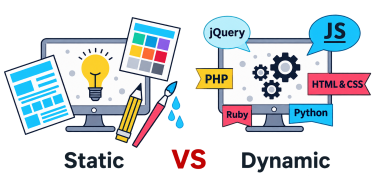
- SSR/CSRSSR (Server-Side Rendering) and CSR (Client-Side Rendering) are two different ways web pages can be built. SSR means the server prepares the web page before sending it to the user's device, while CSR means the web page is built on the user's device using JavaScript.
- DNSDNS (Domain Name System) is like the phonebook of the internet. It translates human-readable website addresses (like www.encodino.com) into the unique numbers (IP addresses) that computers use to find each other on the internet.
- CDNCDN (Content Delivery Network) is like having copies of your website or app stored in different places around the world. It helps make your website or app load faster for users by serving it from a location closer to them.
The world of web development is huge but it doesn't mean it has to be daunting because of these confusing jargons.
Thank you for joining us on this journey of demystifying web development jargons. We look forward to sharing more insights and practical knowledge in the future. Until then, happy learning.